

Views: 26 Author: Site Editor Publish Time: 2026-07-28 Origin: Site


In the landscape of modern industrial manufacturing, maintaining a stable indoor climate is not a luxury—it is a prerequisite for product quality, production efficiency, and employee comfort. However, for workshops with high-frequency logistics and constant personnel movement, the main entrance and loading bays often become the primary source of energy hemorrhage. Every time a forklift passes through a bay door or an employee walks through a personnel entrance, a massive exchange of air occurs. This phenomenon, known as "air infiltration" or "thermal bleeding," forces HVAC systems to work overtime to compensate for lost conditioned air. Fortunately, a simple, cost-effective solution exists: the standard PVC door curtain (PVC strip curtain). Often overlooked, this transparent barrier acts as a "silent guardian" for energy conservation, capable of slashing air conditioning costs significantly.
To understand how PVC curtains save money, one must first understand the mechanics of energy loss in an open doorway. In summer, hot external air (often 30°C+) rushes into a cooled workshop (maintained at 22°C–24°C). In winter, the opposite occurs, with precious heated air escaping while cold winds enter. This isn't just a temperature exchange; it’s a pressure-driven event.
Stack Effect: Warm air is lighter than cold air. In a tall workshop, warm air rises and creates positive pressure at the ceiling, forcing air out through any available opening, while cold air is drawn in at the ground level.
Wind Pressure: External winds create pressure differentials against the building envelope. Wind hitting the exterior pushes air in, while suction on the leeward side pulls air out.
Mechanical Induction: Forklifts and other machinery moving through doorways act like pistons, dragging air with them as they enter or exit.
Without a barrier, an open doorway can lose thousands of cubic meters of conditioned air per hour. This forces compressors to run longer cycles and fans to spin faster, consuming vast amounts of electricity. Standard PVC door curtains interrupt these physical processes, offering a low-cost shield against nature.
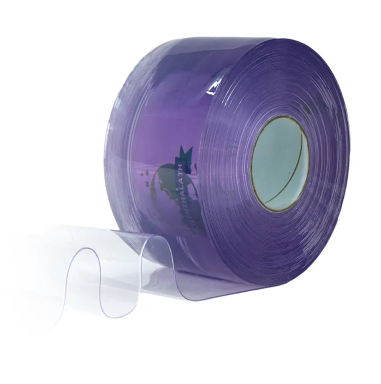
Standard PVC door curtains are composed of multiple flexible strips suspended from a header rail. Their energy-saving mechanism is rooted in physical obstruction and aerodynamic buffering.

Creating a Dynamic Airlock: Unlike rigid doors that must be fully opened, PVC strips part only as much as necessary to allow passage. Once the obstruction (person or vehicle) passes, gravity causes the strips to immediately reseal. This creates a "dynamic airlock" or "air buffer zone" that dramatically reduces the velocity of air exchange.
Thermal Insulation Properties: Polyvinyl Chloride (PVC) is a poor conductor of heat. Even a standard 2mm thick PVC strip offers a measurable R-value (resistance to heat flow). By covering the door opening, the curtain reduces radiant heat transfer and conductive losses.
Minimizing Infiltration: Because the strips overlap (typically by 50mm to 100mm), they block the "stack effect" and wind-driven infiltration far more effectively than a single rigid panel might, as there are no large gaps at the edges.
The financial impact of installing PVC curtains is not theoretical; it is supported by empirical data and industry studies.
Energy Reduction Rates: Depending on the climate, door size, and traffic frequency, installing high-quality PVC strip curtains can reduce HVAC energy consumption by 15% to 50%. In high-traffic loading docks, savings often hover around the 30%–40% mark.
Reduced Compressor Cycling: Air conditioning systems consume the most power during startup. By stabilizing the internal temperature, PVC curtains reduce the frequency of compressor cycling. This not only saves electricity but also extends the lifespan of expensive HVAC equipment by reducing mechanical wear and tear.
Case Study Insights: In a typical food processing facility maintaining a 4℃ cold storage environment, replacing a swinging door with a PVC strip curtain reduced the refrigeration load by nearly 35%. In an automotive assembly plant, summer cooling costs dropped by an estimated 22% after installing magnetic PVC curtains at all major bay entries.
Not all PVC curtains are created equal. To maximize energy savings, procurement managers must match the curtain specification to the specific workshop environment.
Standard Clear Overlap: Best for pedestrian doors and light-traffic areas. The overlapping design ensures a basic seal while remaining inexpensive. However, for high-efficiency needs, this is often the minimum standard.
Magnetic PVC Strips: These are the gold standard for energy conservation in busy workshops. Small magnets are embedded along the edges of the strips. After a vehicle passes through, the magnetic force pulls the strips tightly together, eliminating gaps that allow air leakage. Tests show magnetic curtains can block over 80% of air convection.

Ribbed or Polar Grade: For environments with negative pressure (exhaust systems) or extreme cold (freezer rooms), specialized curtains are required. Ribbed strips resist sticking together in windy conditions, while polar-grade PVC remains flexible at -40℃, preventing cracks that would ruin the thermal barrier.

Anti-Static and Anti-Insect: While primarily functional, these specialty curtains contribute to energy efficiency indirectly. By preventing static-induced dust buildup (which can clog AC filters) or deterring insects (reducing the need to open doors for pest control), they help maintain a cleaner, more efficient airflow system.
 |  |
The best curtain will fail if installed incorrectly. Proper implementation is key to realizing the ROI.
Correct Sizing and Overlap: The curtain must be wider and taller than the opening. A minimum overlap of 50mm per strip is recommended for general use, increasing to 100mm for temperature-critical areas. Insufficient overlap creates permanent gaps that negate energy savings.
Secure Mounting: The header rail must be anchored securely to the lintel. If the rail sags, the strips will not align vertically, leaving diagonal gaps. Stainless steel or galvanized steel brackets are preferred for durability.
Bottom Clearance: Maintain a 10mm to 20mm gap between the bottom of the strips and the floor. This prevents dragging (which wears out the strips) while still blocking the majority of airflow. For windy environments, weighted bottoms or brush seals can be added.
Regular Inspection and Cleaning: Over time, PVC can accumulate dust, oils, and grime. A dirty curtain restricts airflow initially, but more importantly, it can become opaque, forcing workers to hold doors open longer to see. Clean curtains with mild soap and water quarterly. Replace any strips that are torn, cloudy, or have lost their flexibility, as damaged sections compromise the entire barrier.
While the primary focus is on reducing AC costs, PVC curtains offer secondary benefits that contribute to the bottom line. They reduce noise pollution from machinery by acting as a sound dampener. They keep out dust, pollen, and flying insects, improving the cleanliness of the production environment. Furthermore, the transparency of the curtains improves safety by allowing forklift operators and pedestrians to see through the barrier before crossing, preventing collisions.
In the pursuit of operational efficiency and sustainability, industrial managers often invest in expensive smart thermostats or high-efficiency chillers. However, one of the most cost-effective upgrades is often the simplest: the installation of standard PVC door curtains. By creating a flexible, self-sealing barrier, these curtains disrupt the physics of air exchange, stabilize internal climates, and significantly reduce the workload on HVAC systems. With a rapid payback period—often less than a year—and benefits extending to safety and hygiene, PVC door curtains are an indispensable tool for any workshop looking to cut costs and improve environmental control. Welcome to our website: www.pvccurtain.com to know more about our products.


